



none
Communications
Enhance Your Messaging Strategy
Campaign Nucleus Communications empowers your messaging with a suite of tools to help you stay consistent, monitor media coverage, engage on social media, manage press releases, run targeted email campaigns, and respond to crises with ease.
Connect. Inform. Engage.
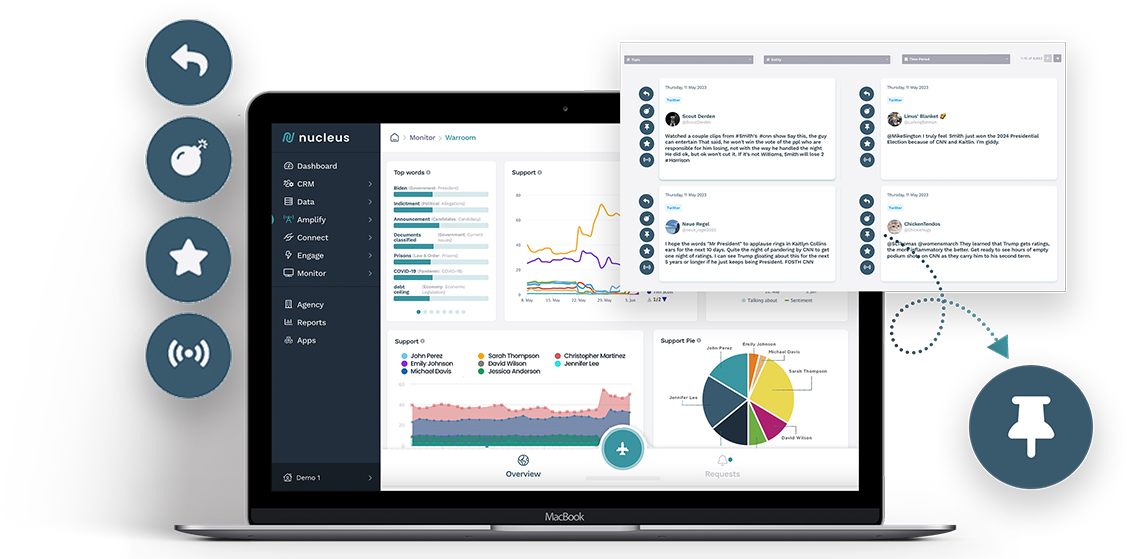
Stay on top of media coverage with real-time updates from global and local sources. Monitor public sentiment, trends, and respond proactively to shape the narrative.
Keep your messaging aligned across all platforms to ensure that your campaign’s values and key points resonate effectively.
Create, manage, and distribute press releases seamlessly, ensuring your message reaches the right people, at the right time.
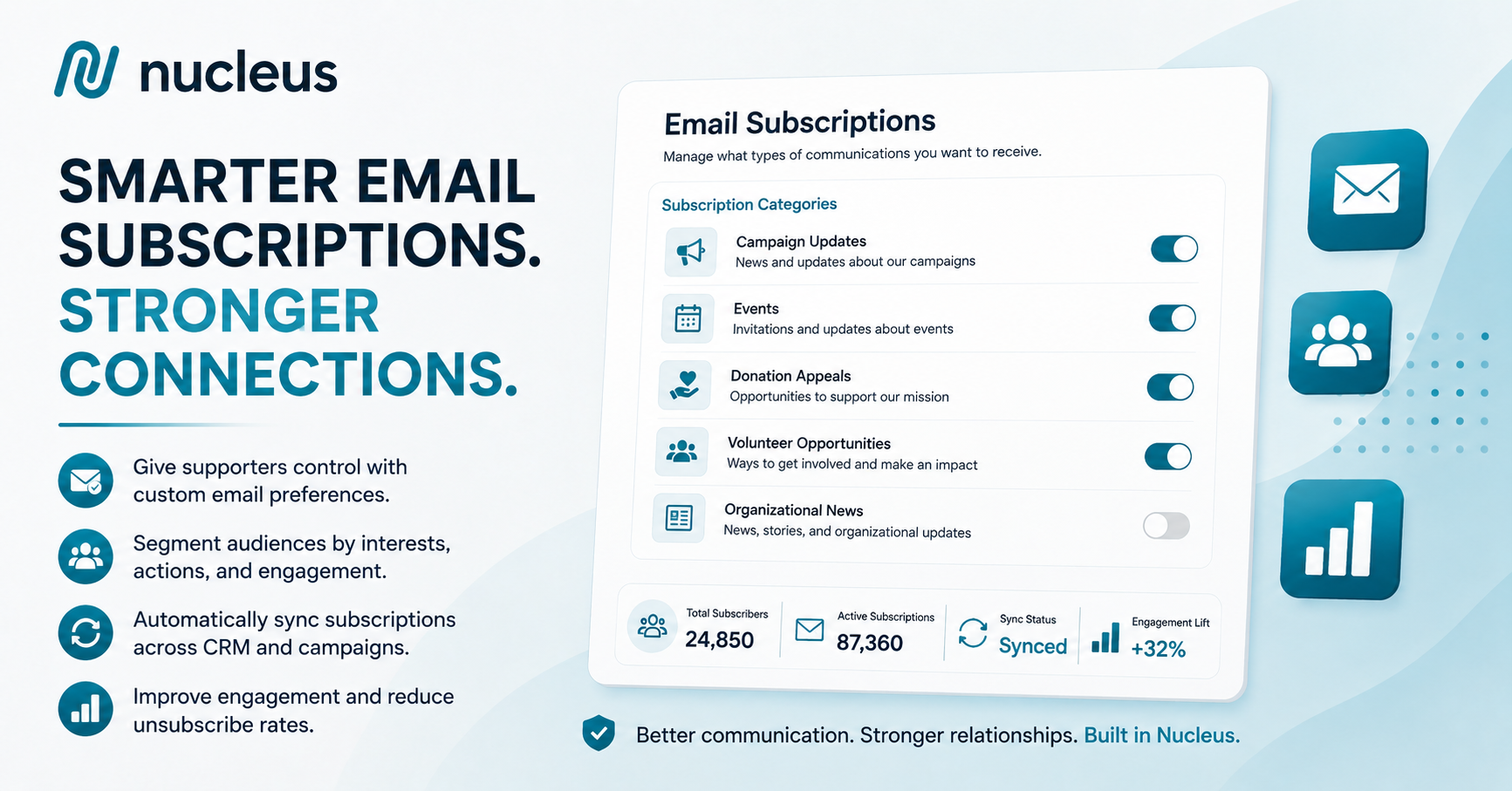
Run personalized, segmented email campaigns that speak directly to your audience’s interests, driving engagement and action.
Handle crises effectively with tools that allow real-time monitoring and pre-prepared responses to safeguard your reputation.
Use our tools to schedule posts, monitor engagement, and analyze trends on social platforms to boost your campaign’s presence.
Make data-driven decisions with in-depth analytics to measure performance, optimize messaging, and drive continuous improvement.
Campaign Nucleus delivers incredible support... quick response times... exciting new features... dedicated to innovation and excellence.
–Lori , Nonprofit Organization
Nucleus is a game-changer... handles everything in one platform... super easy to use... keeps everything organized and efficient. Highly Recommend!
–Terri , Political Organization
Grateful for the hands-on, responsive help... customer service is top-notch... combines multiple tools into one platform... saves time and keeps everything in sync.
–Cathy , Fundraising
Nucleus is a game-changer for email deliverability... its unique batching feature tailors audience sizes per domain for optimal ISP performance... with a user-friendly interface and robust analytics, it’s perfect for elevating your email strategy.
–John , Digital Agency
Nucleus is a fantastic platform with the best support and it is tailored perfectly to meet the needs of the industry.
–Liam , Digital Agency
Nucleus customer service is top-notch—friendly, professional, and always eager to help. Whenever I’ve encountered a technical issue, they’ve provided expert assistance, solving problems quickly and thoroughly. They are always ready to jump in and offer support. Truly dependable and a pleasure to work with. Highly recommended!
–Tommy , State Party
As the CEO of Nexus Advertising Strategies, I’ve worked with numerous vendors... but Nucleus stands out. Their fulfillment services deliver consistent results... the platform is user-friendly, support is responsive... I trust Nucleus—and that trust has paid off.
–Ron , Agency
Switching to Nucleus was a game-changer. Within 24 hours, we saw a 35% jump in email deliverability and doubled our open rates. Our audience targeting became dramatically sharper — and our campaigns started converting faster. The difference was immediate and measurable.
–Direct Persuasion , Nonprofit Fundraising Client
Related Blogs
Deliverability
Emails
Tips
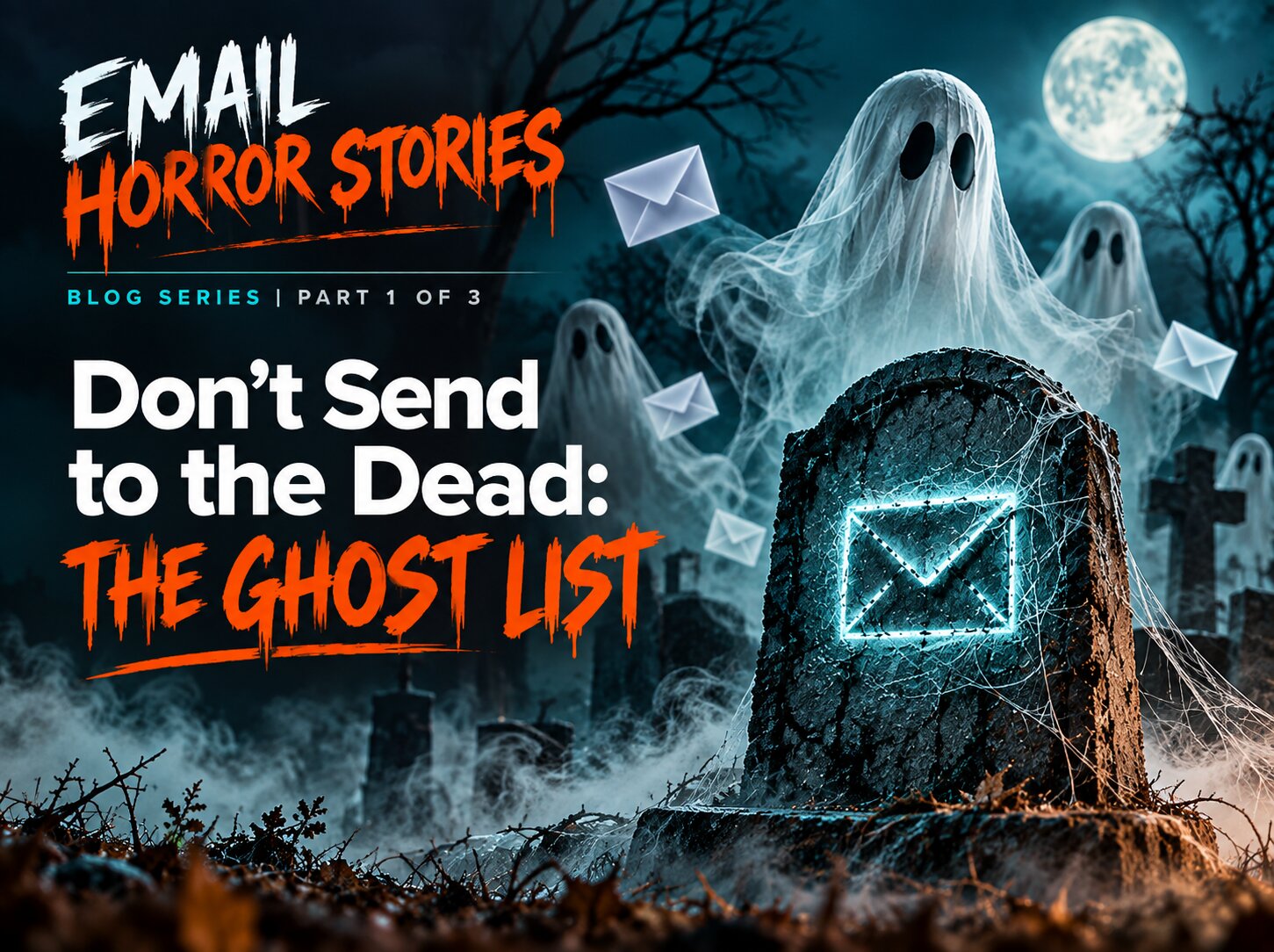
Deliverability & Email Chaos Theory: The Basics
April 15, 2026
Series Edition: Section 1 - The Basics
Why Your Emails Might Be Going to the Spam Folder
A Stat That Should Scare You
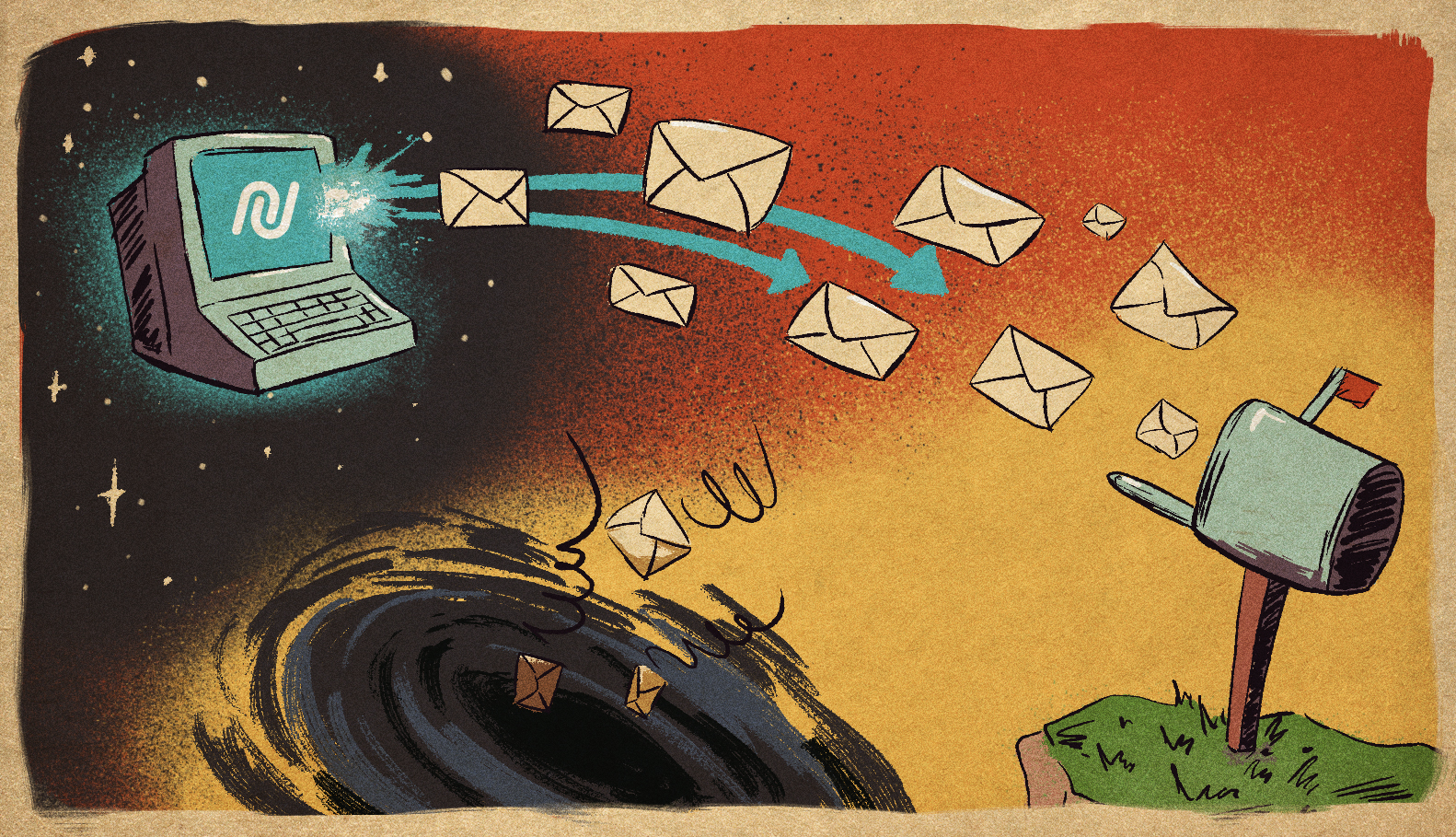
The thing is, 1 in 6 actual emails never makes it to the inbox.
Not spam, not wrong addresses, actual emails from actual companies to actual people who opted in to receive them. Poof, gone!
If you've ever sent 1,000 emails in the past month, you've probably already lost 170 of them to the spam folder or bounced before anyone ever sees them. If you've ever sent 100,000 that's 16,900 emails that no one will ever read.
And the worst part is, you probably don't even know it's happening!
Most people look at their email reports and they say, "Sent: 10,000 | Delivery Rate: 99%." But that 99% "delivered" rate doesn't tell you if they were delivered to the actual inbox or the actual spam folder. That's two totally different results.
So... What Even IS Email Deliverability?
Email deliverability is a simple idea, but messy in practice:
It's the question of whether your emails actually show up in people's inboxes, not spam folders, not promotional folders, not nowhere folders.
That's it. That's the whole idea.
Deliverability is not about getting your email out the door from your server. You can send an email with no problem, but it can end up in a spam folder. Deliverability is the difference between "sent" and "seen."
Here's a way to think about it:
Sending an email is like putting a letter in the mail. Deliverability is like getting it delivered to the doorstep, rather than the junk mail heap.
Deliverability vs. Inbox Placement: What's the Difference?
This is where a lot of confusion happens. These two terms get used interchangeably, but they're not the same thing.
Metric | Email Deliverability | Inbox Placement |
Definition | Whether your email is technically delivered to the mail server without being rejected (bounced). | Whether your email actually lands in the recipient's primary inbox (not spam, promotions, or tabs). |
What It Measures | Technical acceptance by mail servers. Bounces (hard/soft). | Success with spam filters. Whether algorithms let it through. |
Typical Rate | 98-99% (if your list is clean) | ~83% (industry average) |
The Trap | You think you're winning. The email reached a mail server, so it's "delivered." | But it's sitting in spam. Nobody sees it. No engagement. Lost opportunity. |
So, here’s the real talk: a 99% delivery rate means nothing if only 75% of those emails get into the inbox. You’re celebrating your emails making it to the mail server while your revenue opportunities are in the spam folder.
Why Should You Even Care?
Because it impacts your business in three ways:
1. Revenue loss before anything else happens
If 17% of your emails don't make it to your customers' inboxes, that's 17% of your sales, customers, sign-ups, or engagement that just... disappears. Before they even see your email, before they decide to not buy from you, before anything, and nothing happens. That's money on the table that you'll never see.
2. Your sender reputation gets damaged
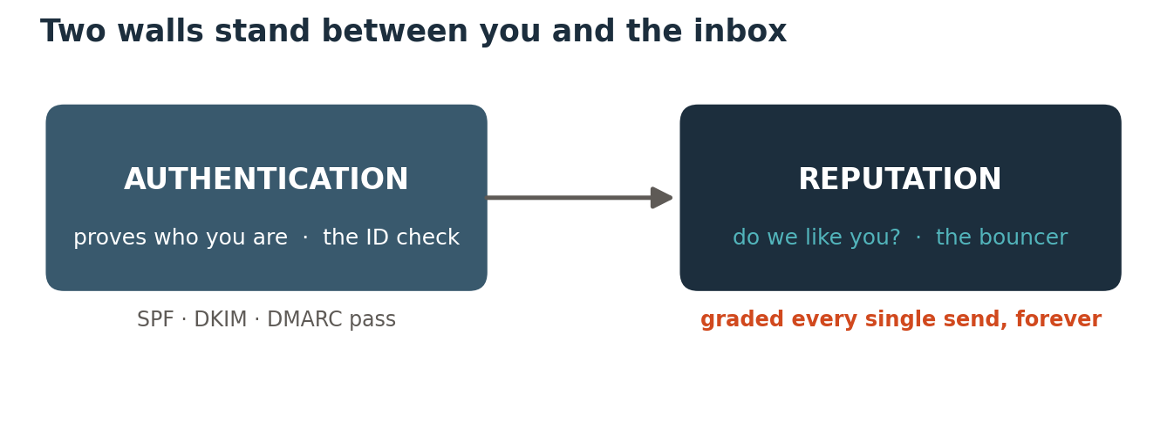
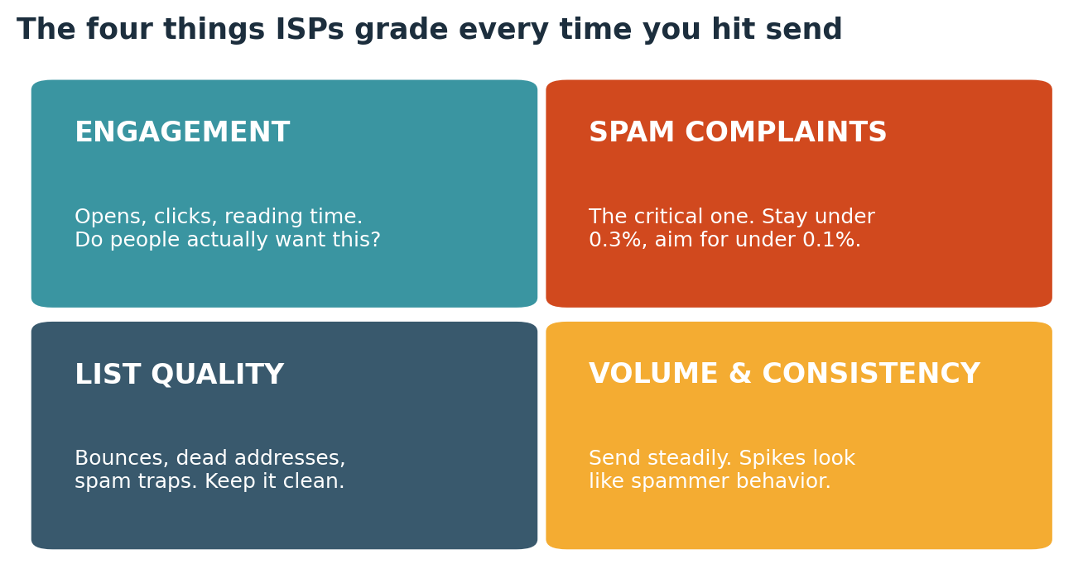
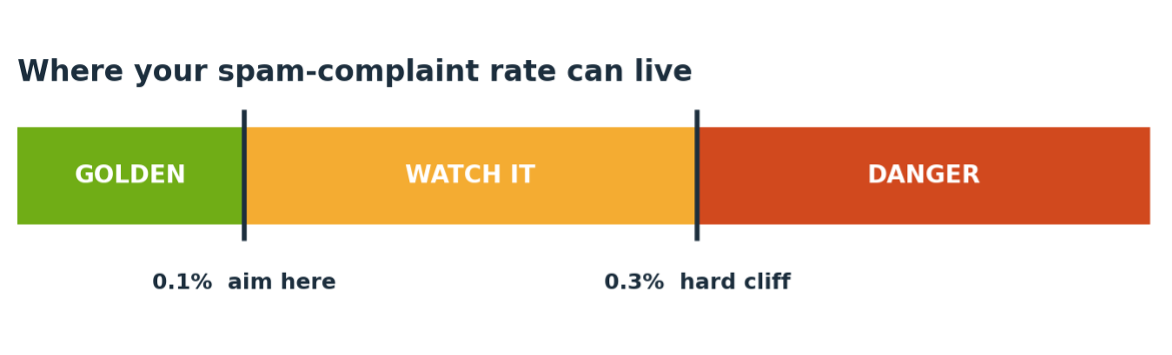
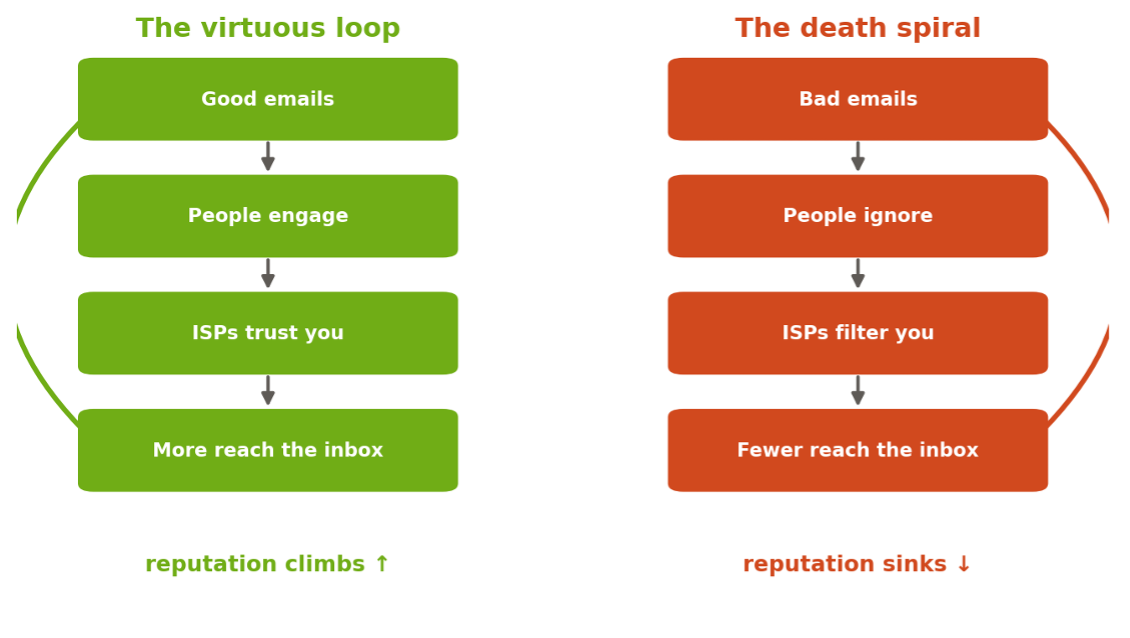
ISPs (Gmail, Outlook, Yahoo, and so on) monitor your email performance. If people are ignoring your emails, deleting your emails, and marking your emails as spam, an ISP will be thinking: "This email sender is not trustworthy." And the worse your reputation gets, the stricter their spam filters will be on your emails. So, your best emails will end up in spam because an ISP already determined that you're a suspicious email sender.
3. Trust is lost, and it happens quietly with each unseen email
Your customers will unsubscribe from your emails because they never see your emails in their inboxes. Your open rates will be terrible. Your team will wonder if email marketing is even working anymore. Meanwhile, email deliverability is quietly slipping under the radar.
The Chaos Part: Dozens of Systems Are Judging Your Emails
Here's where it gets crazy.
Because when you hit "send" on that email, it doesn't go directly to that person's inbox. Before that happens, it has to go through dozens of invisible checks and filters, all at the same time, all with different rules.
Gmail's got its own algorithm. Yahoo's got its own rules. Outlook's got its own rules – and they're all totally different. And then there are all the authentication systems like SPF, DKIM, and DMARK (don't even get me started on those).
Then there's your reputation score as a sender, and your domain's reputation score, and how many people are actually engaging with your emails, and whether or not you're accidentally sending spam keywords in your content...
And that's still not even all of it.
Each one of these email providers has its own way of doing things, its own way of weighing all these different variables and determining whether to deliver your email.
It's chaos. Beautiful, algorithmic, invisible chaos.
But here's the good news: it's not random chaos.
There are patterns and rules and things that you can control.
And that's what this whole series is about.
The Real Question
Before we delve deeper into who and what is responsible for checking your emails, ask yourself:
Do you know what percentage of your emails actually land in the inbox today?
Not sent. Not delivered. Land in the inbox. Where actual humans can see them.
If you don't know the answer to this question, it's totally fine. You're not alone. Most teams don't track it until something goes wrong. But the space between "sent" and "seen" is where all your problems reside.
In the next section, we'll be introducing you to the unseen actors in your email's journey: the ISPs, spam filters, authentication protocols, and algorithms working together to determine your email's fate.
Spoiler alert: it's going to change everything.
Key Takeaway
Email deliverability is the space between sending an email and it arriving in someone’s inbox. The sad truth is that 1 in 6 legitimate emails never makes it to the inbox, which means revenue and engagement are slipping through your fingers before you ever get a chance to engage with them in the first place. And it’s not because of any one thing, it’s a system of invisible checks and filters all working together to pass judgment on every single email you send. The good news is, it’s all based on a system of rules, and understanding them is the first step to winning at email.
Start sending emails today!
Already a Nucleus user? Visit your Nucleus Resource Library for more!
Emails
Features
Productivity
What’s New in September
October 1, 2025
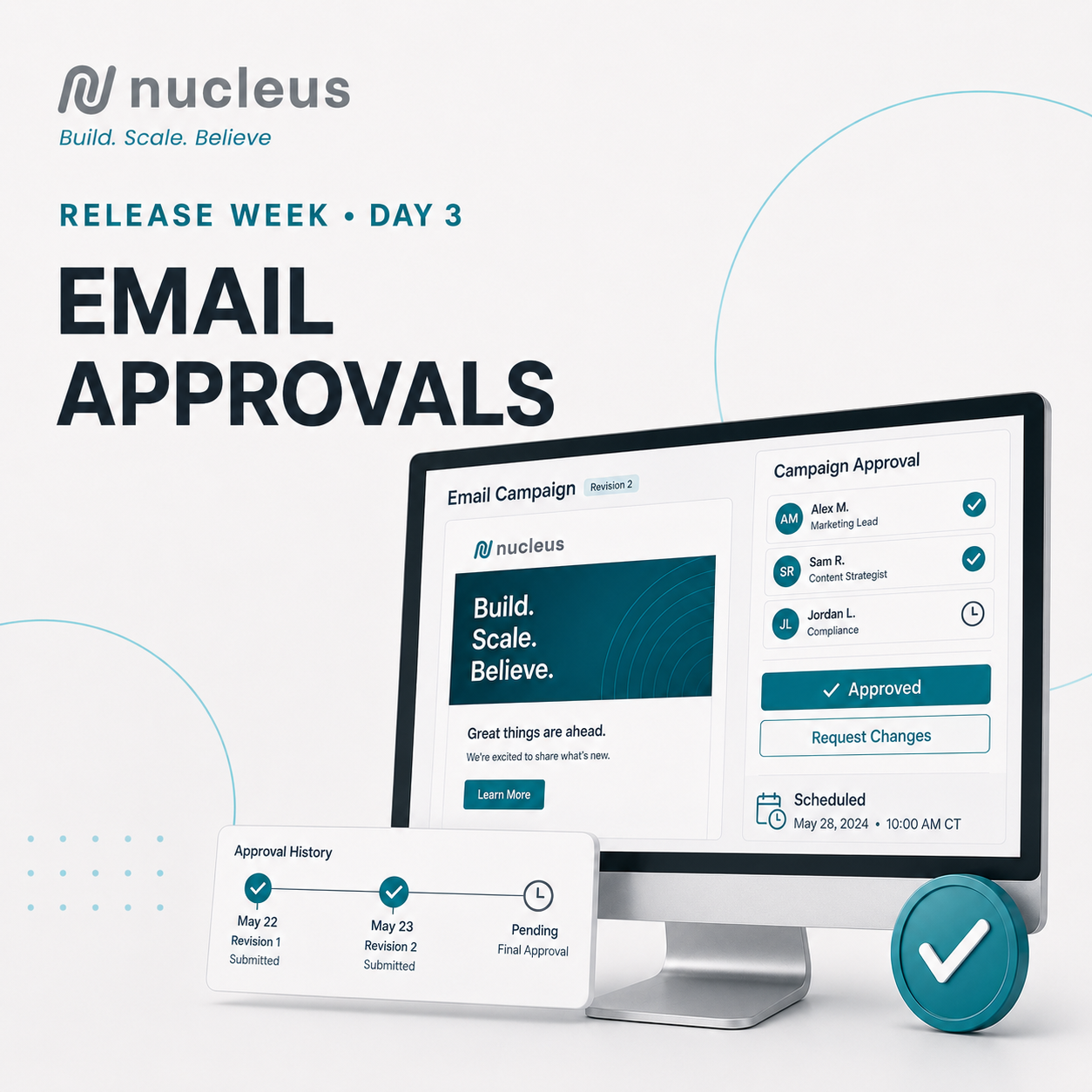
We’re always working to make Nucleus faster, smarter, and easier to use. This month, we’re rolling out a fresh set of updates designed to give you better visibility, streamlined management, and more customization across your campaigns and CRM tools.
Here’s what’s new:
Dashboard: Countdown Widget
Keep your team on track with our new comprehensive countdown widget. You can now easily track campaign deadlines and milestones right from your dashboard — making it simple to stay organized and meet your goals on time.
Email: Smarter Sorting & Filtering
Managing your campaigns just got easier and more insightful.
Performance-Based Sorting – You can now sort campaigns by open and click rates, giving you a quick view of what’s performing best.
Repeating Status Filter – Filter email campaigns by their repeating status to manage recurring sends more efficiently.
Data Feeds Refresh Button – Instantly refresh your data feeds with one click to ensure you’re always viewing the most up-to-date campaign insights.
Export as PDF – Need a record of your sent emails? You can now download and save them as PDFs for reporting or compliance.
CRM: Gender Segmentation
Personalization just got a boost. Gender has been added as a segmentation criterion in the CRM Segment Builder, allowing for even more targeted and relevant outreach.
Memberships: Renewal Period Filtering
Simplify membership management with our new renewal period filter. You can now view and filter members based on their renewal dates — helping you track upcoming renewals and plan your outreach effortlessly.
Stay Ahead with Nucleus
These updates are all about giving you better control and smarter insights across your campaigns, contacts, and memberships. From deadline tracking to personalized segmentation, Nucleus continues to evolve with the tools you need to move faster and connect more effectively.
These updates are live now, so dive in and explore the new possibilities!
Texting
Tips
Updates
IOS Is Changing Texting: Here’s What This Means for Your Campaign
August 14, 2025
If your campaign uses texting to reach voters, volunteers, or donors, there are important changes coming that you should be aware of. Apple is starting to support something called RCS messaging, which could be quite significant for political outreach. These changes will shape how messages are delivered and what they look like on voters’ phones—especially for those who aren’t using iPhones.
What is RCS and Why Should You Care?
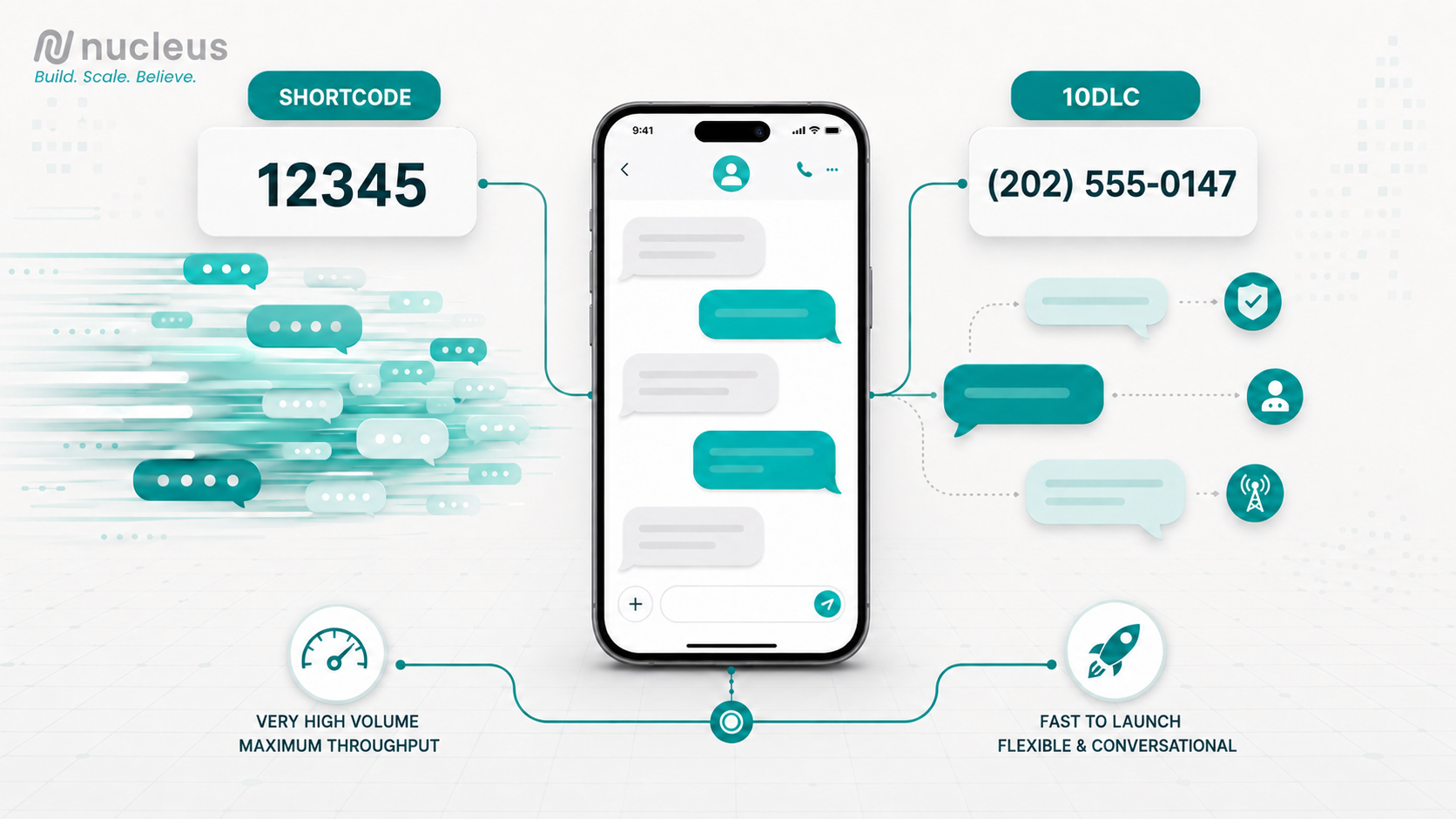
RCS stands for Rich Communication Services—essentially the next generation of SMS. Some new features include higher-quality images and videos, real-time typing indicators, read receipts, and interactive buttons. Until now, these capabilities were primarily available only on Android devices. However, with iOS 18 and planned updates through iOS 26, Apple is now embracing RCS.
For campaigns, this shift opens up new opportunities to engage voters in more dynamic and responsive ways. Higher-quality media, clickable calls-to-action, and real-time communication could significantly improve the impact of your outreach.
But There’s a Catch
Even with Apple supporting RCS, not every voter will be updated to the new system right away. Without the right tools, keeping track of who can receive RCS messages versus standard SMS could quickly become overwhelming.
How Campaign Nucleus Makes a Difference
Campaign Nucleus was built for moments like this. Even as the messaging ecosystem changes, we ensure your engagement stays effective and seamless.
When someone registers for an event, donates, or signs up to volunteer, Nucleus captures their phone number automatically—helping you grow a compliant, opt-in list without manual list management. From there, Nucleus sends automated follow-ups to each recipient’s device, regardless of the message type they can receive.
If they have RCS enabled, they’ll enjoy the updated experience with richer media and interactive features. If not, they’ll still get your message through standard SMS. Our platform also ensures compliance with built-in opt-out tracking, audience segmentation, and limits on message types.
Why This Matters Now
Campaigns that adapt early will benefit most from the shift to RCS. As more voters start using RCS-enabled devices, your outreach can stand out in ways it never could before. Higher-quality visuals, interactive buttons, and real-time engagement lead to better results—but only if your infrastructure is ready.
Emails
Engagement
Volunteers
No Strangers Here, Just Friends You Haven’t Met
April 10, 2025
If you walked up to a stranger on the street and asked them for $20, odds are they’re going to look at you like you're crazy and walk away. I cannot blame them; I’d do the same. Now… what if, instead, you engaged them in conversation, swapped contact information, developed a friendship over the course of many weeks, and THEN asked for $20? You might have a better shot.
Well, in some ways, email marketing is a lot similar. People are much more likely to support a cause that they are familiar with and trust. So, with that in mind, it might be time to consider how we can be building trust with our subscribers so that we see the most possible success with our emails.
This means that we need to provide content that makes the recipient feel valued as opposed to just another donor. Before we ask for money and support, we need to show the subscriber how much they matter to us; that we do not just care about their wallets.
So what kind of content can we send out that would align with this goal of building trust? I have a few ideas…
Newsletters and informational content
- These emails can be used to inform your recipients on your mission and the news you find most important. Subscribers will be able to see how their values align with your own and, in turn, may acquire more support for your cause.
Feedback
- Do not be afraid to ask your subscribers about their opinions. Whether you need advice on how to go about things or you’d like to know what you can do better in the future, your recipients should be the first people you ask. Their opinions matter most!
Prospecting
- Sometimes the easiest way we can appeal to our subscribers is to ask them what they care to hear about. Our Nucleus CRM allows us to quickly tag our recipients so we can be ensuring we are reaching out to them with their interests in mind.
These are just a few types of emails we can be sending to our subscribers to ensure that we are building trust before forcing asks down their throat. I think you’ll all find that embedding a little love and care into all of our emails will always pay off in the long run.
For more information regarding how to send less aggressive copy while yielding higher return, contact our team for training or insight and visit your Nucleus Resource Library!
OR
Start sending with Nucleus today | Click here!
Emails
Onboarding
A “Warm” Welcome for Your Subscribers
March 27, 2025
Making the small talk count
I have mentioned the importance of not solely producing content with a “Call to Action” for your subscribers. These types of requests can range from contributing a donation, making a purchase, signing up or subscribing to pages, joining groups, attending seminars, and so many other things. Sometimes… your recipients just need some validation that they are valued before they contribute anything to your cause.
This type of content is especially important during the warming phases of an email marketing campaign, as it helps retain satisfied recipients and foster stronger relationships. By providing valuable, informational content without a direct call to action, you focus on nurturing the relationship and building trust with your audience, rather than pushing for an immediate conversion. This approach allows recipients to engage with your brand on their own terms, creating a more organic connection and improving brand loyalty, which ultimately helps strengthen your sender reputation and boosts long-term deliverability.
With that in mind, it can be difficult to think of ways to produce this type of content. I am here to help!
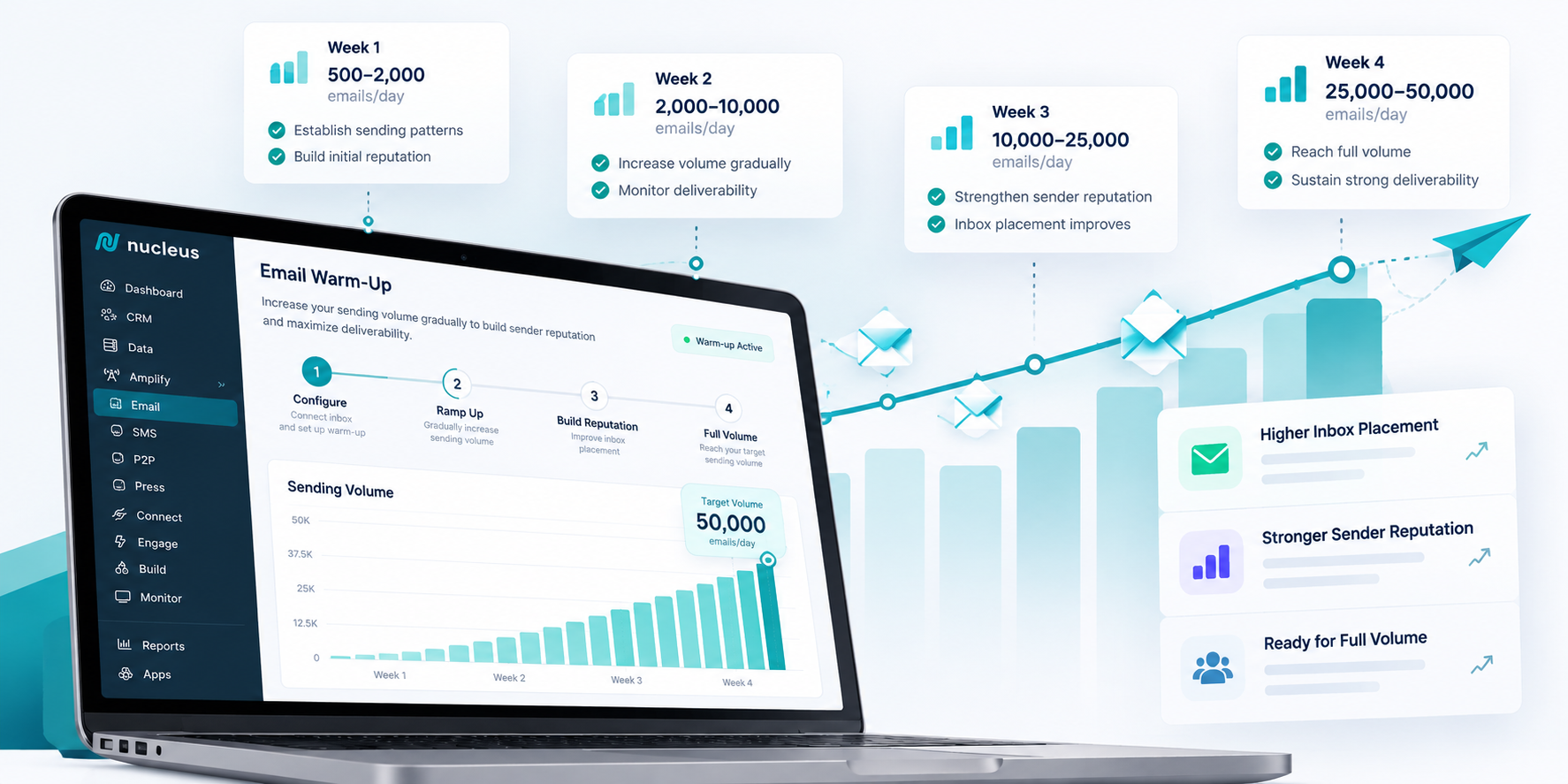
Before we begin, it's important to remember that readers typically have a short attention span. This means we should avoid overloading our emails with too much information. Instead, we can break up the content into smaller, easy-to-digest pieces across multiple emails. This not only helps ensure recipients fully absorb the valuable information but also allows you to create a series of emails, which will be useful as you scale up your sending audience during the warming process.
Now… onto the topic of content.
Below, you can find some great prompts to use when creating these value-driven emails:
- Mission Statement
- What is the primary mission of your organization?
- Financial goals (without asking for contributions)
- What types of programs/uses are funds allocated to?
- Leading Values
- If there are multiple values, these can be spread among various emails
- Testimonials/Stories
- Any related personal stories (i.e. volunteer experiences, funding success, company origins, etc.)
- Company Updates
- Any recent success or changes within the company
- Newsletters/Educational Resources
- Informational content that may directly impact your users
- Leadership Introductions
- Allowing your recipients to be familiarized with your team leaders
- Community Impact
- Expressing any recent community initiatives and exceptional accomplishments
- Ethical practices
- Ensuring all subscribers are aware of certain key values and practices
- General Gratitude
- Simply thank those who have chosen to support your cause thus far
I hope this has given you a bit more insight into how you can leverage different types of emails to drive success, even when you're not focusing on a direct call to action. By strategically using informational and value-driven content, you're able to engage your audience in a way that builds trust, fosters relationships, and keeps them invested in your brand. Remember, sometimes the most powerful emails are the ones that simply inform and educate, allowing you to nurture your audience without the pressure of pushing for immediate action.
For more information, contact our team for training or insight and visit your Nucleus Resource Library!
OR
Start sending with Nucleus today | Click here!
Automation
Emails
Operations
Batching Review: Batcher UP!
March 12, 2025
Through the years, we’ve made plenty of improvements and updates to our batching system & with that, I think it’s time for a little review session…
First, we’ll review how to set-up a batch. Then, we are going to review our Nucleus-recommended scaling technique. And lastly, we’ll put your skills to work and run through some examples. Let’s begin!
Set-Up
At the top, we have our selections concerning ‘batch size.’ While I do occasionally see a reason to utilize the ‘percentage’ or ‘remainder’ function (hence its existence), I find that the ‘fixed’ batch size is easiest to manage when warming a new domain, so I recommend taking that route. Below your selection, you can identify the exact volume of recipients you’d like to send to.
Your ’schedule’ is used to determine how each individual batch will be initiated. I generally base this decision off personal comfort and need.
Manual entails the individual sending of each campaign by a user following the campaign launch.
Start means the batches will begin with the start of the campaign – this is likely the easiest option for users.
Delayed would allow you to set times for the batches to be released following the launch of the campaign.
In our ‘reoccurring’ section, you can implement a reoccurrence of batches. I generally do not recommend using the ‘repeat’ selection while warming a new domain/IP as this can affect our reputation, but when it is utilized, I recommend not exceeding more than one send in a 24-hour period.
In order for the batch to send, you will have to set your ‘Status’ to ‘ready’ as it is automatically placed in ‘draft.’
Finally, you can select the email servers that you’d like to include or exclude from your batch. I find that it is easiest to have an individual batch for every server; this allows you to monitor deliverability in the most efficient manner possible.
For more information, contact our team for training or insight and visit your Nucleus Resource Library!
OR
Start sending with Nucleus today | Click here!
Deliverability
Emails
Stop, Drop, and Roll… For Emails
February 13, 2025
Disclaimer: We encourage “rolling” in the case of fire… Just not emails
By Julia, Deliverability Expert
Similar to the response time one may have to being engulfed in flames, I will make this insightful tidbit brief and to the point.
When it comes to block mitigation and server communication, we cannot control how the server responds… or even IF they respond. What we CAN control is how WE respond to the block.
To help make this as simple as possible, our email team has developed a memory tool from the simple and commonly-known (well, I hope it’s commonly known…) phrase “Stop, Drop and Roll.”
STOP
Stop sending completely
Pros – The issue will not progress/worsen; may help to refresh or recover IP/domain reputation
Cons – Domain/IP warming progress may be reversed (in some cases to the point of restarting)
DROP
Drop sending volume
Pros – Can halt a block or prevent further damage; may help to defend our sending practices in server communications
Cons – Can just prologue the inevitable (block) or prevent throttling limits from ever increasing
ROLL
Roll with it (proceed as you would if no issue occurred)
Pros – In rare cases, this issue resolves itself with no loss of volume or engagement for future sends
Cons – In many cases, this worsens the block, making it harder to resolve in this case and future cases for an indefinite amount of time
In contrast to one who may be caught on fire, our team actually discourages “rolling” in response to emailblocks and deliverability errors in most cases. As in the game of poker or the investment of stock, your risks should always be calculated.
Having reviewed that information, keep in mind that every case is different, and nothing is ever definite in the world of email marketing.
If you think you may have encountered a deliverability issue to any capacity and are considering how your team should respond, do not hesitate to reach out to your point of contact for further assistance.
For more information, contact our team for training or insight and visit your Nucleus Resource Library!
OR
Start sending with Nucleus today | Click here!
Emails
Features
Operations
What’s New in January: Features Update!
February 3, 2025
We’re kicking off the year with some powerful updates to start your operations and year off right! Here’s what’s new in January:
Subscriber History in Email Subscribers – Gain better insights into your subscribers with a detailed history of their activity, helping you track engagement and interactions over time.
New Email Templates UI – Crafting emails just got easier! Our improved email template interface offers a more intuitive and user-friendly design, making it simpler to create and edit your email templates.
Customizable VIP Approval Emails – Now, you can tailor VIP approval emails to align with your brand’s messaging and tone, ensuring a seamless experience for your exclusive audience.
Export Failed Rows from Any Import – Encountered issues during an import? No problem! You can now easily export failed rows for quick troubleshooting and corrections, saving time and effort.
Already a nucleus user? Check out this new feature for yourself!
Want to experience these features and the solutions Nucleus can offer your team?
Emails
Tips
Every Email Deserves a lil’ TLC
December 5, 2024
By Julia, Deliverability Expert
“I don't want no scrub, a scrub is an email that can't get no love from me.”
Here at Campaign Nucleus, we want to make it as easy as possible for our users to produce the most successful email content possible. With that our team has done some research and put together some information we’ve found helpful in creating our own emails.
Let’s start simple – what are the things that every recipient is going to notice about your email?
- Your sender
- Your subject line
- Your content
Now let’s talk about how we can utilize all 3 of these factors to create the MOST TOP NOTCH EMAIL possible!!
Sender:
When you see an email in your inbox, what is the first thing you see? Likely, the sender’s name. Are you more likely to open an email that appears to be sent from a specific person or one that declares a corporation. Likely, a specific name.
Well, your audience feels the same. This means you can improve your user engagement simply by using a more personalized sender, such as a team member, to make your communications seem more “human”and less “AI generated.”
For example, an email being sent from Julia from Nucleus may perform a bit better than one being sent from the Biden Administration (although that may have more than one reason for performing poorly…).\
With that, consistency is also always key – it’s a good habit to keep one sender and domain affiliated with each type of content being sent.
Subject Line:
Following the sender, you likely immediately notice the subject line affiliated with the email.
When it comes to subject line, there are a couple things to keep in mind:
- Topic – always make sure your subject line sticks to the point. No one wants to open an email that has nothing to do with the subject line… it appears deceiving
- Length – your subject line length can actually drive your engagement. Short subject lines (below 50 characters) & longer subject lines (above 70 characters) actually have been found to receive more engagement than average-length subject lines.
Content:
The last thing the recipient will see but generally the most important portion of the email for them to see.
There are lots of considerations to be made when designing our content & every audience type responds differently to different copy types.
We encourage individuality in your sends but here are a few things to keep in mind:
- Be concise – the average human has a reading attention span that ranges from 10-15 seconds… that isn’t very long.
- Consider your call to action – it’s good practice to include multiple links within the email & our system makes it easy to determine where your audience is engaging the most within your email.
- Always check variables – we want to make sure we do not address our recipients as “Hello %recipient.first%.”
- Make your email readable – this includes but is not limited to:
- Having a nice layout – easy to read & pictures should never outweigh text
- Using color and branding wisely
- Ensuring pictures are high enough quality that they engage your audience (although too much data can slow your email load time & that isn’t great either)
For more information be sure to contact our team for training or insight and visit your Nucleus Resource Library!
OR
Want to get on the platform that sent 6 BILLION emails in the last 90 days leading up to Election Day? Click here!
Emails
Reputation
Only Time Will Tell (Or) Time Heals all Wounds (Domains)
November 21, 2024
A tale of how hard work (eventually) pays off
By Julia, Deliverability Expert
When we are in a court of law, we are hopefully paying regards to the phrase “innocent until proven guilty.”
Well… when it comes to servers responding to your sending domains and IPs, it is quite the opposite. You must prove your domain to be worthy of delivering to your recipients without an existing precedent… sometimes before you can effectively deliver at all.
Now that the campaigning cycle is coming to another end, this is a great opportunity to work toward preparing your domains and IPs for the most success when the cycle begins picking up again. I think the most important take-away here is: PREPARE your sending domain BEFORE YOU NEED to send with it.
I want to take a few minutes to review how pre-emptively preparing your sending domains can be beneficial to you in months to come.
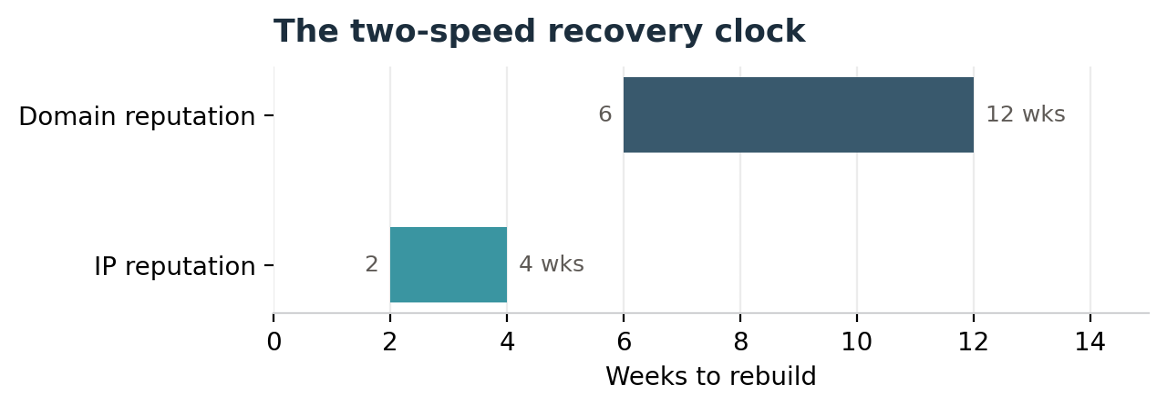
It takes TIME to scale your domain up to your full sending volume. By getting an early start you are able to avoid rushing the warming process, which could cause you to have blocks and trouble with deliverability.
Even after you’ve scaled to full sending volume, it takes TIME for a server to trust you. Servers are constantly watching how their recipients are engaging with your emails & designated a reputation to your domain/IP based off that response. The only way to continuously improve your reputation, especially on Google and similar servers, is for your audience to be consistently positively engaging with your emails. This means the same users repeatedly engaging with your emails, so sending to only new recipients constantly is actually very poor practice.
And it takes TIME for your audience to recognize and engage with your content. This is a great opportunity to focus less on ads and asks, and more on branding and informational content. It can be extremely valuable to produce very non-controversial content that includes little to no ‘call to actions.’ This type of content generally performs much better in the eyes of the server so it can help you to build your reputation up a bit so you have a buffer when you do want to send more hard-hitting content.
Many of the questions I regularly receive are concerning how quickly we can fully scale a domain & the truth is… there are so many things at play when you are preparing a new domain/IP for sending that the best thing you can do is get a head start. There are very few issues I’ve seen not be able to solved with a little time and persistence.
For more information be sure to contact our team for training or insight and visit your Nucleus Resource Library!
OR
Want to get on the platform that sent 6 BILLION emails in the last 90 days leading up to Election Day? Click here!
Start winning with us today
Experience the true power of Campaign Nucleus. Unleash potential with our command center, where collaboration, cost reduction, and enhanced communication drive success.
Start Winning